We carry out tree removal across Halifax, from Warley and King Cross to Skircoat, and travel out to nearby Elland, Sowerby Bridge and Brighouse. We check for tree preservation orders and conservation areas before work starts anywhere in Halifax, and submit any notice needed on your behalf.
Taking a tree down is the last resort in tree care, but sometimes it is the only sensible one. A tree that is dead, decaying at the base, split by a storm or growing into the foundations of a house in Halifax is a liability, and it does not get safer with time. Halifax Landscaping & Driveways removes trees for homeowners, landlords and businesses, from a self-sown sycamore behind a garage to a mature beech dismantled piece by piece over a conservatory.
Tree removal in a garden is rarely a matter of felling. Most trees we deal with in Halifax are hemmed in by buildings, fences and neighbours' property, so they are climbed and taken down in sections, with each piece rigged and lowered on ropes. That takes training, the right equipment and insurance for work at height, all of which our team has.
Before a chainsaw starts we check for tree preservation orders and conservation area status and handle the application. We also look for nesting birds and bat roosts. If a tree can be saved by pruning instead, our Tree Pruning service is often the better route, and we will say so. Overgrown hedges and shrubs are handled under Hedge and Shrub Maintenance.
Hazardous Tree Removal
A hazardous tree is one that is likely to fail and has something beneath it that will be damaged when it does. The target might be your house, a neighbour's extension, a parked car or a footpath. Where gardens are close together, almost every mature tree has a target of some kind.
The signs we look for are decay at the base, often shown by fungal brackets; cavities in the trunk; cracks and included bark at major forks; a lean that has recently increased, with soil heaving on the opposite side; dieback in the crown; and large areas of bark loss. Not every defect means removal. A tree with a hollow trunk can stand for decades if the remaining shell is sound, and we assess honestly before recommending felling.
When removal is the answer, the method depends on the defect. A tree with a rotten base cannot be climbed safely, so we work from a platform or use a crane for the largest specimens. A tree with a sound trunk but a dangerous limb is climbed and dismantled from the top down, with every section rigged and lowered away from the target.
We provide a written condition report with our quote, which is useful for insurance and for council applications where the tree is protected. Dangerous trees can be removed under an exemption from preservation order consent, but the council must be notified and evidence kept, and we manage that for you.
Storm-Damaged Tree Removal
Winter gales and summer thunderstorms leave a trail of split limbs, hung-up branches and uprooted trees across Halifax every year. A storm-damaged tree is more dangerous than it looks, because the loads in the timber are unpredictable: a trunk under tension can spring when cut, and a lodged limb can drop without warning. This is not a job for a borrowed chainsaw.
We respond quickly to storm damage. The first task is to make the site safe, which may mean removing a hanging branch from over a path or clearing a tree from a drive. Then we assess whether the rest of the tree can be saved. A tree that has lost a single limb can often be pruned back and left to recover. One that has split down the trunk or lifted its root plate usually cannot.
Uprooted trees are the trickiest. The root plate can swing back into the hole with great force when the weight of the trunk is removed, so we cut in a specific order and sometimes anchor the plate first. Trees lying on fences, sheds or neighbouring gardens are dismantled from the top so the structure beneath is released gradually.
Where the damaged tree is protected, it can be removed under an exemption with notice to the council, and we photograph the damage before work starts. We can liaise with your insurer, since storm damage is often covered. All timber and brash is cleared, and we can plant a replacement tree if the council requires one.
Small Tree Removal
Not every tree removal in Halifax involves ropes and rigging. Many of the trees we take out are small ones in the wrong place: a self-sown sycamore crowding a fence line, a leylandii planted too close to the house, a conifer that died in a dry summer, a cherry lifting the patio, or a tired old apple in the way of a redesign.
Small trees up to about six metres can usually be felled or sectioned from the ground with a chainsaw and a pole saw, which makes them quick to remove. We still plan the work: we check what the tree will land on, clear the drop zone, use wedges and ropes to control the direction, and cut in sections where the space is tight. Trees against fences or walls are taken down in pieces so nothing is damaged.
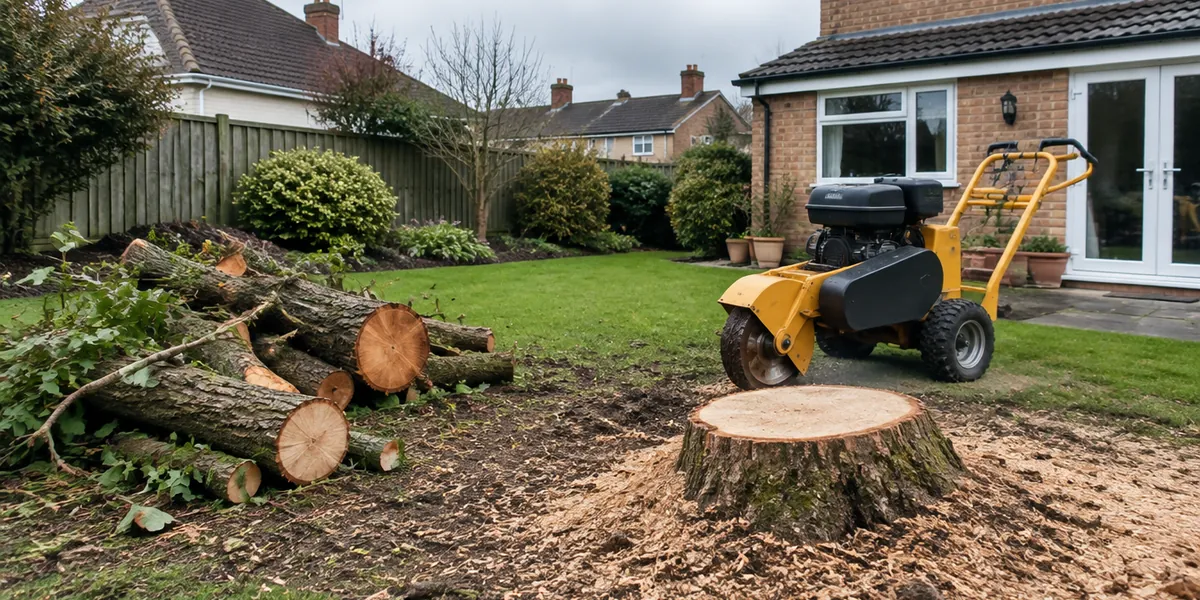
The stump is the question that follows. We can cut it flush with the ground, grind it out to around 300 mm below the surface so the area can be turfed or paved, or treat it to stop regrowth. Sycamore, willow, poplar and elder sucker vigorously from an untreated stump, so for those we recommend grinding or treatment. Where a new driveway or patio is going on top, grinding deeper keeps the sub-base off decaying roots.
Small trees are still subject to preservation orders and conservation area rules, and we check before starting. We also look for nests between March and August. Arisings are chipped, logs stacked or removed, and the ground left level and raked.
Why Choose Us for Tree Removal in Halifax
Tree removal is dangerous work and unforgiving of shortcuts. Our operatives hold NPTC certificates for chainsaw use and aerial tree work, we are insured for work at height, and we follow a written method statement on every job in Halifax. Trees come down in a planned order with every section under control.
We also tell you when a tree does not need to come down. A sound tree with an inconvenient branch wants pruning, not felling. We check for preservation orders and conservation area status, handle the application or notice, and provide a condition report where the removal is on safety grounds.
The site is left clear: brash chipped, logs stacked or removed under our registered waste carrier licence, the stump dealt with as agreed and the lawn or beds raked level. Our work is covered by a written guarantee, and being based in Halifax means we can get to a storm-damaged tree quickly when it matters.
Our Tree Removal Process
- Inspection: we assess the tree's condition, size, lean and surroundings, and discuss whether removal is necessary or pruning would do.
- Consent check: we check the council register for tree preservation orders and conservation area status and advise what permission or notice is needed.
- Written quote and method statement: you receive a fixed price with a description of how the tree will be taken down, what happens to the stump and how the site will be cleared.
- Council application: where required, we submit the paperwork and wait for the decision, or give notice under the dangerous tree exemption with photographs.
- Wildlife check: we inspect for nesting birds and signs of bat roosts before any cutting.
- Dismantling or felling: the tree is taken down in sections by rope and harness, from a platform, or felled from the ground where there is room, with every piece lowered under control.
- Stump and clearance: the stump is ground, treated or cut flush as agreed, arisings are processed and the area is left tidy.
Where the council requires a replacement tree, we can plant one in a better position in your Halifax garden.
How Tree Removal Is Priced in Halifax
The size of the tree and how it has to come down are the two biggest factors. A small tree felled in one piece on an open lawn is a short job. A mature tree between two houses that has to be climbed, dismantled and lowered section by section over a roof is a full day for a team with rigging gear, and the largest specimens may need a platform or a crane.
Condition changes the method. A rotten or storm-damaged tree that cannot be climbed safely has to be dismantled from a platform. Access across Halifax varies from a front garden where the chipper sits on the drive to a rear garden where every log comes through the house.
The stump matters: cutting flush is cheapest, grinding is more, and a stump close to walls or services takes longer. Disposal is charged by volume, and keeping the logs for firewood reduces it. The written quote separates each of these so you can see where the cost lies.
Tree Removal Throughout Halifax
We remove trees throughout Halifax. In Skircoat, if you have a large mature specimen, it is the most involved kind of job, often protected and often needing sectional dismantling over neighbouring property. In Warley and Illingworth, especially in a smaller garden, the typical call is a conifer or self-sown sycamore that has outgrown its space or is lifting a patio. If your plot in Ovenden is exposed, storm damage hits it hardest, and we are usually there within a day or two of a big blow. In King Cross we take down dead ash and declining beech, a common problem in larger gardens. We also cover nearby Elland, Sowerby Bridge and Brighouse.
Many customers combine this with tree and shrub care and tree pruning.
Your Questions Answered
Do I need permission to remove a tree in Halifax?
If the tree is covered by a tree preservation order or your property is in a conservation area, yes. The council must grant consent, or in a conservation area receive six weeks' notice, before the tree is removed. Dead and dangerous trees can be removed under an exemption with notice and evidence. We check the register and handle the paperwork before any work starts.
How do I know if my tree is dangerous?
Warning signs include fungal brackets at the base, cavities or cracks in the trunk, a lean that has recently increased with soil lifting on the opposite side, large dead sections in the crown and bark falling away. None of these on its own means the tree must come down. We inspect it properly and give you a written opinion, which is also useful for insurance purposes.
What happens to the stump after tree removal?
You choose. We can cut it flush with the ground, grind it out to around 300 mm below the surface so the area can be turfed, planted or paved, or treat it to prevent regrowth. For species that sucker, such as sycamore, willow and poplar, we recommend grinding or treatment. Where a driveway or patio is going on top, we grind deeper so the base is not sitting on rotting roots.
Can you remove a tree that has fallen onto my shed or fence?
Yes, and the sooner the better. A fallen tree is under unpredictable tension and should not be cut by anyone untrained. We dismantle it from the top down so the structure beneath is released gradually, deal with the root plate safely and clear the site. We photograph the damage before starting for your insurer and can provide a report to support a claim.
Will removing a large tree affect my house?
It can, on shrinkable clay soils. A mature tree draws a great deal of water from the ground, and removing it can cause the clay to swell over the following years, which occasionally affects foundations. Where we think this is a risk, we recommend a staged reduction over several years instead of immediate felling and suggest you speak to your insurer or a structural engineer first.