Homeowners across Halifax use us for tree and shrub planting, from King Cross and Warley out to Skircoat and nearby Elland, Sowerby Bridge and Brighouse. Every job starts with a free site visit in Halifax, where we measure up, check access and talk through options before sending a written quote.
Tree and shrub planting at Halifax Landscaping & Driveways is the part of our landscape installation service that deals with the long-lived plants: the trees that will shade a patio in ten years, the ornamental trees that give blossom and autumn colour, and the hedges that turn an open fence line into a private garden. We plant for homeowners across Halifax, from a single specimen tree in a front garden to a hundred metres of native hedging along a boundary.
Trees and hedges are the cheapest part of a garden to plant and the most expensive to replace once grown, so the job is worth doing properly the first time: the right species for the soil and the space, a hole dug wide rather than deep, correct depth, a low stake and a flexible tie, mulch and water.
The three services covered here are shade tree planting, ornamental tree planting and privacy hedge planting. We advise on species, check for preservation orders and conservation area rules, source stock from nurseries and plant in the season that gives the best chance of establishment in Halifax's soils. Each job comes with a written quote and a written guarantee.
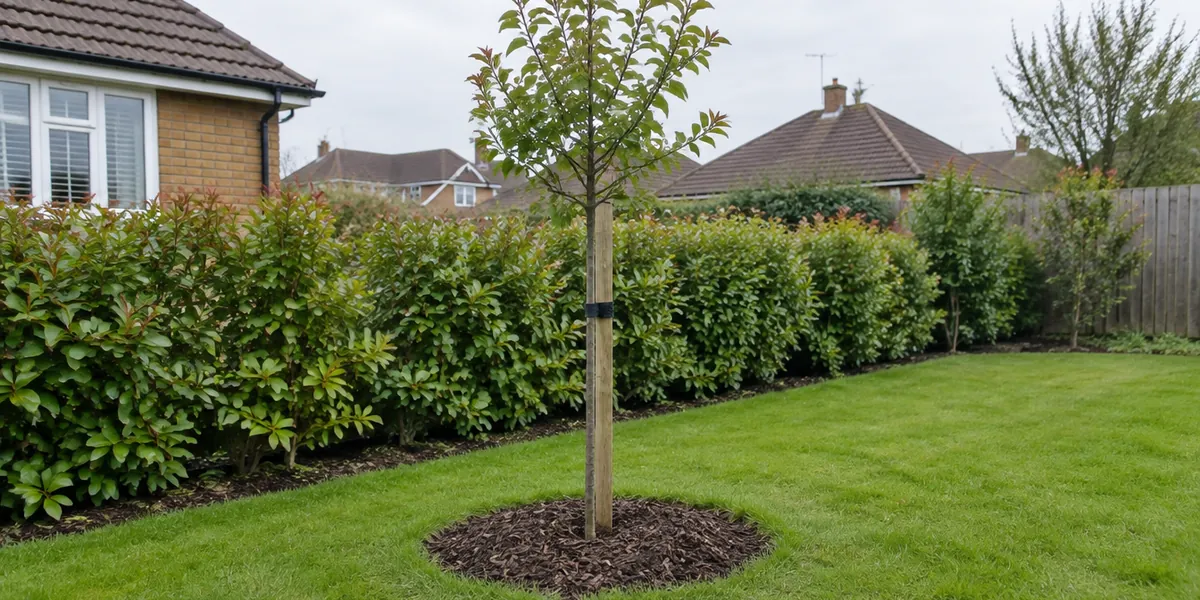
Shade Tree Planting
Shade tree planting is the installation of a larger tree chosen to shade a seating area, cool a south-facing wall or screen an overlooked window. It is the right choice when you have space for a tree that will reach eight metres or more and are prepared to wait a few years for the benefit.
Species choice depends on the plot. For an average Halifax garden we lean on field maple, hornbeam, silver birch, rowan and whitebeam, which give a good canopy without becoming forest trees. On larger plots a small-leaved lime or an oak is an option. We keep large species away from foundations, drains and boundaries, and on shrinkable clay we are careful about distance from the house because roots drying the clay can cause movement.
Most shade trees go in as bare-root or rootballed stock between November and March, at 2 to 3.5 metres, which establishes faster than a bigger container-grown tree and catches it up within a few years. The hole is square, two to three times the width of the rootball and no deeper, with the sides broken up by fork. The tree goes in at nursery depth, backfilled with the excavated soil, firmed and watered with at least 20 litres.
A short stake driven at an angle, or a double stake with a crossbar, holds the rootball still while the top moves freely, and the flexible tie is checked each year. A one-metre mulch circle kept clear of grass for three years does more for a young tree than any feed.
Ornamental Tree Planting
Ornamental tree planting is for trees chosen for what they look like through the year: blossom in spring, berries and colour in autumn, bark or shape in winter. It is the right choice for a smaller garden where a full shade tree would overwhelm the space, for a front garden focal point, or for adding height and season to a border.
The list for Halifax gardens is a long one. Crab apples give blossom, fruit for birds and a compact head. Amelanchier offers white flowers and fiery autumn colour at a modest size. Japanese maples suit sheltered, lightly shaded spots. Flowering cherries, magnolias, hawthorn cultivars and paperbark maple all have their place. We match the tree to the soil, keeping magnolias and acers off chalk, and to the position, since many ornamentals dislike exposed sites.
Ornamental trees are usually container-grown, so they can be planted in any mild month, though autumn is best. We check the rootball and tease out circling roots, because a pot-bound tree never establishes properly. The hole is wide and shallow, the tree sits at nursery depth with the graft union above the soil, and the backfill is the original soil with no compost, which encourages roots to spread rather than stay in the hole.
Staking is lighter for a small tree, often a single short stake for two years. We water deeply through the first two summers and mulch each spring. A well-chosen ornamental tree gives a Halifax garden a focal point that improves every year.
Privacy Hedge Planting
Privacy hedge planting is the installation of a line of shrubs or trees that will grow into a screen. It is the right choice when a fence is not enough, when you want to soften a boundary, or when a new-build plot in Halifax leaves you looking into a neighbour's kitchen. A hedge also cuts wind and noise better than any fence and gives nesting cover for birds.
The species decides the character and the speed. Cherry laurel and photinia give a thick evergreen screen quickly and tolerate most soils. Yew is the best formal evergreen but takes patience. Beech and hornbeam hold their brown leaves through winter and clip into a tight line. A native mix of hawthorn, blackthorn, hazel, field maple and dog rose is the cheapest and best for wildlife, planted as bare-root whips in a double staggered row. We steer clients away from leylandii.
Preparation is a trench rather than individual holes: a strip at least 600 mm wide and a spade deep, weeds and roots removed, the base broken up and compost added. Bare-root hedging goes in between November and March at five plants per metre for a native hedge or two to three for laurel and yew. Plants are set at nursery depth, firmed, watered and mulched along the run.
New hedges need watering for two summers and a light trim in the second year to encourage bushy growth from the base. Hedge cutting is kept outside the bird nesting season, roughly March to August, and we check conservation area rules before any established hedge is removed.
What You Get When We Handle Your Tree and Shrub Planting
We plant trees that are right for the site. A tree is a thirty-year decision, and the wrong species in the wrong place either fails or has to be felled. We look at the soil, the space, the distance to the house and drains, and the exposure, and recommend accordingly, even when that means a smaller tree than you had in mind.
Our planting method is the standard one that works: wide square hole, nursery depth, original soil backfill, low stake, flexible tie, mulch, deep water. Bare-root stock goes in during the dormant season and we avoid summer planting without irrigation. Stock is inspected before it goes in.
We know the rules that affect trees in Halifax: preservation orders, conservation area notice periods and sensible distances from foundations on clay. We tell you about them before work starts.
All planting carries a written guarantee and a written quote. Spoil is removed by our registered waste carrier. If the project also needs beds or mulch, our garden installation and ground cover installation services are done by the same team.
Our Tree and Shrub Planting Process
- Site visit. We look at the position, the soil, the exposure and the distance to buildings and drains, and talk about what you want the tree or hedge to do.
- Species recommendation. A short list of suitable trees or hedging plants with sizes, matched to the site and the budget.
- Checks. Preservation orders, conservation area status and any planning restrictions confirmed before stock is ordered.
- Written quote. Plants, stakes, ties, mulch and labour itemised, with the planting season noted.
- Ordering and delivery. Stock ordered for the right window; bare-root plants planted or heeled in the day they arrive.
- Planting. Holes or trenches dug, plants set at nursery depth, backfilled, firmed, staked, watered and mulched.
- Aftercare. Watering and tie-checking guide for the first two years, and a return visit to adjust stakes if needed.
A single tree takes a morning; a long native hedge can take a day or two. In Halifax we concentrate tree and hedge work between November and March, when plants are dormant and the ground is moist.
What Affects the Cost of Tree and Shrub Planting in Halifax
The size and type of stock drives most of the cost. A bare-root whip costs a fraction of a container-grown tree, which costs a fraction of a semi-mature rootballed specimen that needs a team to move. Bigger is not always better: a smaller tree establishes faster and often overtakes a larger one within a few years.
Species matters too. Native hedging is inexpensive in bulk; yew, pleached trees and named cultivars sit higher. Hedge length and planting density multiply the plant count quickly.
Ground conditions affect labour. A trench through rubble or compacted new-build subsoil in Halifax takes longer than one through a worked border, and removing an old hedge or stumps first is a job in itself. Stakes, ties, rabbit guards and mulch add to the materials.
Access is the final factor: a tree carried through a house costs more to plant than one dropped at the kerb. Every item appears as its own line in the written quote.
Tree and Shrub Planting Across Halifax
We plant trees and hedges throughout Halifax. If your newer home in Illingworth or King Cross has an open fence line, a privacy hedge planted in winter will screen it. In Skircoat and Warley, if your garden is larger and older, a shade tree, or a replacement specimen where an old tree has come down, is often the right choice. In Ovenden, as anywhere, a front garden suits an ornamental tree that stays in scale with the house. From our base in Halifax we cover all of these and nearby Elland, Sowerby Bridge and Brighouse.
Common Questions
How far from the house should a tree be planted?
It depends on the species and the soil. On shrinkable clay, large water-demanding trees like willow, poplar and oak should be kept well back, often the height of the mature tree or more. Smaller ornamentals can be closer. We assess the soil and recommend a safe distance at the site visit.
How quickly will a privacy hedge give me screening?
Laurel or photinia planted at 1.2 to 1.5 metres will usually give a reasonable screen within two to three years. Native bare-root hedging starts smaller but thickens fast. Yew and beech take longer but last for decades. Planting larger stock buys time but costs more and establishes more slowly, so we usually suggest a middle size.
Do I need permission to plant a tree in Halifax?
Planting a new tree in your own garden does not normally need permission. Removing or pruning an existing tree can, if it carries a preservation order or sits in a conservation area, where the council needs notice. We check both before any existing tree or hedge is removed to make way for new planting.
Should I stake a new tree?
Yes for anything above about 1.5 metres. A short stake, one third of the tree's height, driven at an angle into the undisturbed soil, with a flexible tie, holds the roots still while letting the trunk flex and strengthen. Ties are loosened as the tree grows and the stake removed after two to three years.
What is the best time to plant a hedge?
Between November and March for bare-root hedging, which is the cheapest way to plant a long run. Container-grown plants can go in at any time of year if they are watered, but autumn gives them the best start. Avoid planting into frozen or waterlogged ground, which damages the roots and the soil structure.