Homeowners across Halifax use us for fencing and gate installation, from King Cross and Warley out to Skircoat and nearby Elland, Sowerby Bridge and Brighouse. We confirm boundary ownership and height limits on every Halifax job, and flag up front anything that would need planning consent.
Fencing and Gates from Halifax Landscaping & Driveways covers new boundaries, replacement fences and the gates that go with them, for homeowners across Halifax. We install panel fencing, close-board and featheredge fencing, concrete posts with gravel boards, and timber garden gates and side gates. It is the service for anyone whose fence has blown over in a storm, whose posts have rotted at ground level, or who wants more privacy than a sagging run of old lap panels can give.
A fence is only as good as its posts. Most of the failures we are called to in Halifax are timber posts that rotted where they meet the soil, or posts set in a shallow pot of concrete that rocked loose. We set posts deep, keep timber off the ground and use galvanised or stainless fixings so nothing rusts out.
Before any work starts we talk about the boundary itself: who owns it, where the line runs and how tall the new fence can be.
Fence Panel Installation
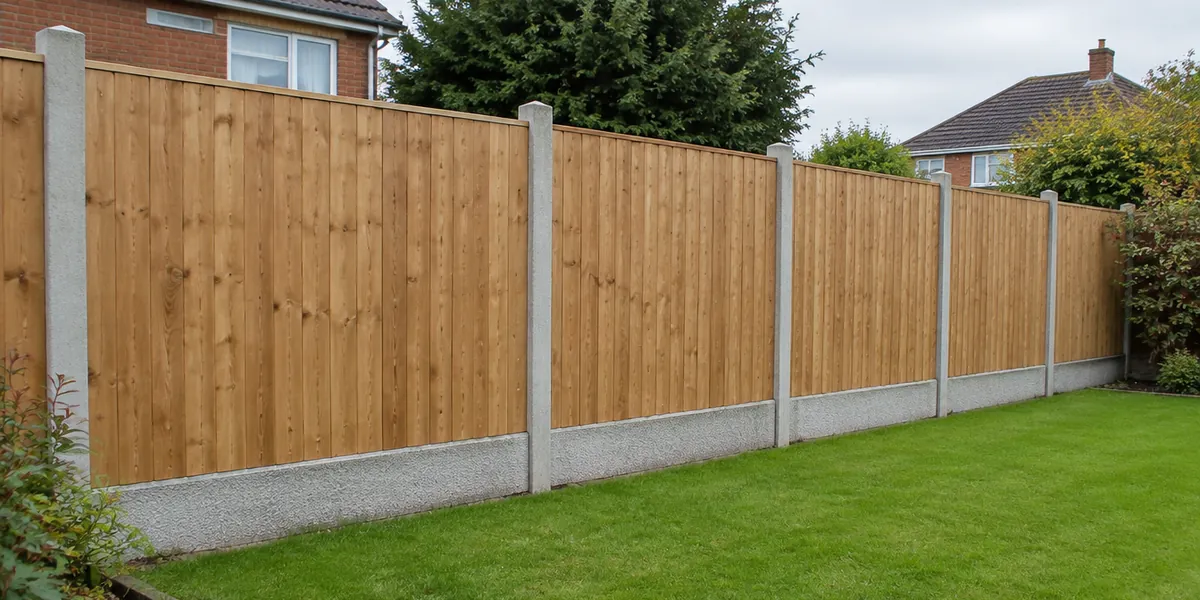
Fence panels are pre-made sections, usually 1.83 metres wide, that slot or screw between posts. They are the quickest way to put up a boundary and come in several styles: overlap or lap panels, closeboard-style panels, slatted contemporary panels with horizontal boards, and hit-and-miss panels that let some wind through. Panels are the right choice for a straight, fairly level boundary where speed and a tidy, uniform look matter.
We set out the line with a string and dig post holes at least 600 mm deep, deeper on soft ground or exposed sites, so roughly a quarter of the post is below ground. Posts are set in concrete with a crowned top that sheds water away from the timber. Panels are fixed with galvanised fence clips or dropped into concrete posts, and on sloping ground we step them so each panel stays level rather than racking.
Panels vary a great deal in weight and board thickness. Lightweight lap panels are cheap but are the first to blow out in a gale; heavier pressure-treated panels with thicker boards and a stronger frame last much longer. If your boundary catches the wind, we may suggest a slatted or hit-and-miss design, which lets gusts through rather than acting like a sail.
Close-Board and Featheredge Fencing
Close-board fencing is built on site rather than bought as panels. Timber posts or mortice concrete posts carry horizontal arris or cant rails, and vertical featheredge boards are nailed to the rails, each overlapping the last by about 25 mm. Three rails are standard for a fence of 1.8 metres. A gravel board runs along the bottom, and a capping rail and counter rail along the top keep rain out of the board ends.
It is the strongest timber fence we build and the right choice for exposed gardens, long boundaries and sloping ground, because it follows the slope without steps. Each board is fixed individually, so a single damaged board can be replaced without taking a section down.
We use pressure-treated boards and rails, fixed with galvanised or stainless ring-shank nails so they do not rust and streak the timber. Boards are checked with a level every few metres and spaced from a gauge stick, so the face stays consistent along the run. Cut ends get a brush-on end-grain preservative, because factory treatment does not reach the centre of the timber.
By convention the smooth face of a close-board fence faces outwards, towards the neighbour or the road, with the rails on the owner's side. That is courtesy rather than law, and something we agree with you before we start.
Concrete Posts and Gravel Boards
Concrete posts are the answer for anyone tired of replacing rotten timber. They do not rot or twist, and slotted concrete posts let panels drop straight in from above, so a panel blown out in a storm can be lifted back or replaced without touching the post. Recessed and mortice concrete posts carry close-board fencing with timber rails.
Gravel boards sit at the base of the fence between the posts and keep the timber clear of the soil. They come in concrete, which slots into concrete posts, or in pressure-treated timber. A 150 mm board is common; a 300 mm board helps where the ground is a little higher on one side.
Concrete posts are heavy, so we dig holes at least 600 mm deep and set each post plumb in concrete, braced while it cures, then fit the gravel boards and panels once the concrete has gone off. We can bolt a concrete repair spur alongside a timber post that has rotted only at the base, though on longer runs full replacement usually makes more sense.
Garden Gates and Side Gates
A side gate is often the only thing between the street and your back garden, so it needs to be solid and secure. We make and hang timber gates in ledged and braced, framed and close-boarded, and slatted designs, matched to the fence or the house. Side gates are usually full height with no rails on the outside to climb; gates within the garden can be lower and lighter.
The braces on a gate run diagonally up from the bottom on the hinge side, so the weight is carried back to the hinges and the gate does not drop. We hang gates on heavy-duty T-hinges or adjustable hook-and-band hinges, from posts of 100 or 125 mm set deeper than ordinary fence posts, because a gate puts a lever load on them. Where one side is brickwork, we fix a timber post to the wall with resin anchors.
Security comes from the ironmongery: a lockable bolt or padbolt on the inside, a ring or thumb latch, and a gap underneath too small to reach through. Gates next to a pavement are hung to open inwards, so they do not swing over the footway. If you need a wider opening for a mower or a car, we build double gates with a drop bolt into the ground.
Why Choose Us for Fencing and Gates in Halifax
We start with the boundary, not the fence. Before quoting we look at the title plan, the deeds and any existing posts, and if it is unclear whose fence it is, we suggest you speak to your neighbour first.
On site we keep things neighbourly. If we need to stand in next door's garden to fix boards, we only do it with their agreement, and we leave both sides clean. We also check the height you want against permitted development: up to 2 metres in most places, including any trellis on top, and 1 metre next to a highway.
Posts go in deep, timber stays off the soil, fixings are galvanised or stainless and every cut end is treated. Old fencing leaves with us as registered waste carriers, and the finished job comes with a written guarantee.
Our Fencing and Gates Process
- Survey: we walk the boundary, measure it, note slopes, trees and services, and talk through ownership and height.
- Quote and choices: you get a written quote covering post type, fence style, gravel boards, gates and ironmongery.
- Removal: the old fence, posts and buried concrete are dug out and loaded for disposal.
- Setting out and posts: we run a string line, dig holes to depth and set each post plumb and to height in concrete.
- Panels or boards: once the concrete has set, gravel boards go in, then panels or rails and featheredge boards, with capping where specified.
- Gates and finishing: gates are hung and adjusted, ironmongery is fitted, cut ends are treated and the site is tidied.
A typical back-garden boundary in Halifax takes one to three days. If you want a coloured stain, new treated timber is best left to dry out first, and we will tell you when to apply it.
Fencing and Gates in Halifax: What Changes the Price
Length and height are the obvious factors, but the post type is the biggest choice. Timber posts are cheaper to fit; concrete posts cost more at first but rarely need replacing. Close-board fencing costs more than standard panels because it is built board by board, and heavy-duty panels cost more than lightweight lap panels.
Ground conditions change the labour. Digging post holes in firm soil is quick; hitting old concrete, rubble, roots or heavy clay is not, and slopes mean stepped panels or close-board that follows the ground. If the existing fence and posts have to come out first, removal and disposal are part of the price.
Gates are priced separately and vary with size, design and ironmongery. A plain ledged and braced gate is simpler than a framed, full-height side gate with a lockable bolt, and double gates need heavier posts. Access matters, as does any staining or painting. Each item appears on the quote.
Fencing and Gates Across Halifax
We put up fences and hang gates throughout Halifax, including Skircoat, Warley, Illingworth, Ovenden and King Cross, and in nearby Elland, Sowerby Bridge and Brighouse. If your garden adjoins other gardens on both sides, we will help you agree the work with your neighbours before we start. If your front boundary runs along a road, the 1 metre limit applies, and we can suggest a low fence or our garden wall construction service instead. If you are planning patio installation or decking installation as well, we can programme the fencing first so the new surface is not damaged.
Customers in Halifax often ask us about hard landscaping at the same time.
Your Questions Answered
How high can a fence be without planning permission?
Under permitted development a fence, wall or gate can be up to 2 metres high, measured from ground level and including any trellis on top. Next to a highway used by vehicles, including the pavement alongside it, the limit is 1 metre. If your home is listed or in a conservation area, tighter controls may apply, so we check before quoting.
How do I know which fence is mine?
Start with the title plan and deeds for your property, which you can obtain from HM Land Registry. Some show T marks indicating who is responsible for a boundary, but many do not, and title plans usually show only general boundaries. If it is still unclear, speak to your neighbour and agree the work in writing before anything comes down.
Which side of the fence should face my neighbour?
By convention the smooth, finished face goes outwards, towards the neighbour or the road, with posts and rails on the owner's side. It is not a legal requirement, but it is good manners and looks tidier from outside. If both households will see the fence, a double-sided panel or a hit-and-miss design looks right from either side.
Are concrete posts better than timber posts?
For most boundaries, yes. Concrete posts do not rot at ground level, which is where timber posts usually fail, and slotted posts let panels be swapped without disturbing the post. Timber posts look more natural and suit some close-board fences. With good treatment, deep concrete footings and gravel boards, timber posts still give long service.
Should I tell my neighbours before fencing work starts?
Yes, especially on a shared boundary, and we are happy to talk them through the plan. If we need access to their side to fix boards or remove an old fence, we only go in with their permission. We keep noise reasonable, work sensible hours in Halifax and leave both gardens tidy at the end of each day.