We offer driveway drainage maintenance across the whole of Halifax, including Warley, Illingworth and Skircoat, as well as nearby Elland, Sowerby Bridge and Brighouse. Every quote in Halifax covers the base, edges and drainage as well as the surface, so you know what is causing the problem before you pay to fix it.
Most driveway drains in Halifax are not broken. They are full. Silt, leaves, moss, gravel and the fine grit that washes off every surface collect in channels, gully pots and culverts until the water has nowhere to go. Halifax Landscaping & Driveways clears and cleans driveway drainage for homeowners who want their drive to keep draining through the wet months without the cost of a repair. It is a routine job, ideally done once a year in autumn after the leaves have come down, and it is the single most effective way to avoid the puddles, ice sheets and damp garage walls that follow a blocked drain.
While we have the gratings up we check the channel joints, the gully trap and the pipe outlet, and look for the early signs of a fault: a crack, a dropped section, a grating that is starting to go. Catching these during a clean is far cheaper than dealing with them after the system has failed.
The three sections below cover channel drain cleaning, gully cleaning and culvert clearing, followed by how we work and what affects the cost in Halifax.
Channel Drain Cleaning
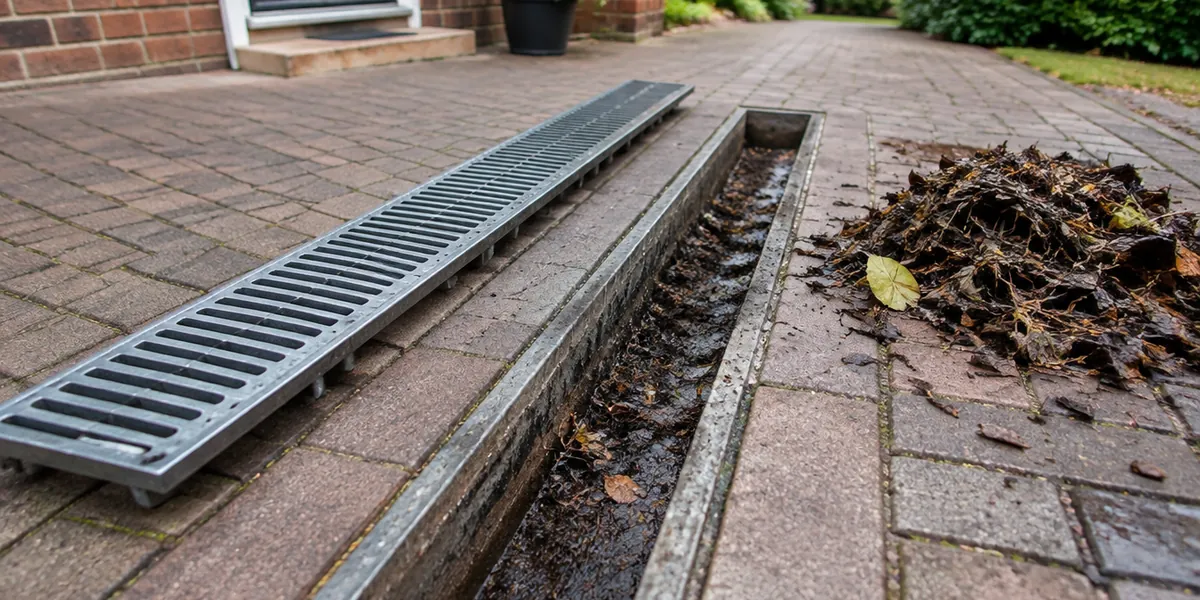
A channel drain sits across the drive exactly where everything washing down the slope ends up. Silt settles along the bottom, leaves mat over the grating, moss grows in the slots and jointing sand works its way in every time a block paved drive is washed. Once the channel is half full it overflows at the lowest point and the problem it was fitted to solve comes back. Across Halifax this is by far the most common drainage call we get.
Cleaning is the right choice whenever the channel is visibly full, when water is overtopping the grating in rain, or once a year as prevention. It is also what we do before sealing or re-sanding a drive, because those jobs push material into the channel.
Gratings are lifted and scrubbed clean of moss and leaves. The channel is scooped out by hand, then jetted from the high end towards the outlet so the silt moves the way the water goes. The outlet and the first length of pipe are rodded or jetted to make sure the channel can actually empty. We check the silt bucket if there is one, inspect the joints and haunch for cracks and settlement, then refit the gratings. Any damage is photographed and noted on a short report.
The length of the channel, how long since the last clean and what has got into it all affect the work. A channel that has taken mortar washings is far harder to clear than one full of leaves.
Driveway Gully Cleaning
A gully pot is designed to trap silt and debris so that it does not travel into the pipework. That means it is supposed to fill up, and it needs emptying before the sediment reaches the outlet pipe. A trapped gully also holds water in its seal, which goes foul with rotting leaves if it is not changed. The signs in Halifax are a gully that smells in summer, a grating that is permanently wet and a slow drain after rain.
Gully cleaning is the right choice at least once a year, more often under trees or at the bottom of a slope, and after any heavy storm. It is also the first thing we try when someone reports a broken gully.
The grating is lifted and cleaned. Silt and debris are scooped or vacuumed out of the pot down to the base. The trap is flushed and refilled with clean water. The outlet is rodded through to the next chamber, or jetted if the pipe is long, so any silt already in the pipe is pushed on to where it can be removed. We check the pot for cracks and make sure the grating sits flush when it goes back, because a rocking grating lets debris in around the edge.
The depth of silt and what is in the pipe beyond decide how long it takes. Gullies neglected for years can be compacted solid and need jetting. We will tell you if Driveway Drainage Repair is needed because the pot or the connection has failed.
Driveway Culvert Clearing
A culvert under a driveway carries a ditch or watercourse through a pipe, and a pipe is only as good as its clearest point. Silt builds up along the invert, branches and leaves jam at the inlet, and vegetation grows across the ends until the opening is a fraction of its size. When the winter rain comes the ditch backs up, water goes over the drive and it starts to wash out. Keeping culverts clear matters for any property reached across a ditch.
Clearing is the right choice every autumn before the wet season, after any storm that has brought debris down the ditch, and whenever water is standing on the upstream side while the downstream side is dry. We will say if the ditch itself is a riparian responsibility you share with a neighbour.
We clear vegetation and debris from both headwalls by hand, then remove the silt from the pipe. Shorter culverts can be done with rods and a scoop; longer or heavily silted ones get a jetting unit from the downstream end so the silt is carried out rather than pushed further in. A camera inspection afterwards confirms the pipe is clear and shows up cracks, root intrusion or crushed sections. We tidy the ditch bed each side so water flows cleanly to the inlet.
The length and diameter of the pipe, the depth of silt, the vegetation over the ends and whether we have to work in flowing water all affect the job. We time culvert work for dry spells where we can.
What You Get When We Handle Your Driveway Drainage Maintenance
Plenty of people in Halifax will clear a gully. We clear it and then look at what is around it, because we install and repair the whole driveway and its drainage. Catching a cracked channel or a sunken pot before winter saves an emergency call-out when the drive floods in January.
We carry rods, a jetting unit, a wet vacuum and a drain camera on the maintenance van, so a blocked outlet does not turn into a second visit. Silt and debris go away with us under our waste carrier registration rather than onto your border or down the road gully.
You get a written quote before we start and a short written report afterwards describing what we found and anything that needs attention. Many customers put us on an annual autumn visit, often combined with a clean and re-sand of the drive, so the drainage is done before the leaves and the rain arrive.
Our Driveway Drainage Maintenance Process
- Walk-round: we identify every channel, gully and culvert on the drive and note where water has been standing.
- Gratings off: all gratings are lifted, cleaned of moss and leaves and checked for damage.
- Clearing: channels and pots are scooped or vacuumed out, and culvert ends are cleared of vegetation and debris.
- Jetting and rodding: channels, outlets and culverts are flushed in the direction of flow until water runs freely.
- Inspection: joints, haunches, traps and pipe runs are checked by eye and by camera where needed.
- Reinstate: gratings are refitted flush and traps are refilled with clean water.
- Report: you receive a note of what was done, photographs and any recommended repairs.
A standard drive in Halifax with a channel and a gully takes an hour or two. A property with a long channel run, several gullies and a culvert is a half-day visit.
What Affects the Cost of Driveway Drainage Maintenance in Halifax
The number and length of the drains come first. One short channel at a garage door is a quick visit; several gullies, a long channel and a culvert take most of a morning.
How long it has been since the last clean makes a difference. Drains cleared annually scoop out easily. Drains that have been left for years are compacted solid, need jetting and produce several bags of silt to remove. What has got into them matters too: leaves and moss are easy, mortar washings and compacted sand are not.
Access to the outlet and the state of the pipework beyond it affect the time if we have to rod or jet a long run. Culvert work depends on pipe length, the amount of vegetation and whether we can work in a dry ditch. A camera survey, if wanted or needed, is itemised separately on the written quote we provide for every maintenance visit in Halifax.
Driveway Drainage Maintenance Across Halifax
We maintain driveway drainage in every part of Halifax and nearby Elland, Sowerby Bridge and Brighouse. If your drive in Skircoat sits under trees, the channel will fill with leaves every autumn, and we can put it on our regular list. In Warley and Illingworth we clear and flush threshold gullies each year before winter, so yours is ready when the heavy rain arrives. If you share a driveway with neighbours in Ovenden, a long channel run may need jetting, and where a property in King Cross has a ditch or culvert at the entrance, we clear it each year ahead of the wet season. For any address in Halifax, we can book a one-off clean or an annual visit.
Many customers combine this with driveway drainage installation and driveway drainage repair.
Your Questions Answered
How often should driveway drains be cleaned?
Once a year is right for most drives in Halifax, ideally in autumn once the leaves have dropped and before the heavy rain. Drives under trees, at the bottom of a slope or with a culvert benefit from a second check in spring. An annual clean keeps silt away from the pipework and lets us catch damage early.
Can I clean a channel drain myself?
You can lift the gratings, scoop out the leaves and rinse the channel with a hose, and that is worth doing between visits. What a home clean usually misses is the outlet and the first length of pipe, which is where the blockage that actually stops the drain tends to be. We rod or jet that through as part of every clean.
My gully smells in summer. Is that a maintenance problem?
Usually, yes. A trapped gully holds water in its seal, and if it fills with rotting leaves and silt that water goes stale. Emptying the pot, flushing the trap and refilling it with clean water solves it. If the smell returns quickly, the trap may be damaged or dry, which we check while we are there.
What happens to the silt you remove?
It is bagged and taken away under our waste carrier registration and disposed of at a licensed site. We do not tip it into your borders, the road gully or a watercourse, since silt washed into a ditch simply ends up blocking the next culvert downstream.
Do you check the drains for damage while cleaning?
Yes. With the gratings off we inspect channel joints and haunches, gully pots and traps and the pipe outlet, and we put a camera down longer runs or culverts if there is any doubt. Anything we find is photographed and noted in a short report so you can decide whether to have it repaired before winter.